Sociology Blog
Modernity, surveillance and identity: To what extent does Lincoln Castle prison embody, in microcosm, the “panoptic” model of surveillance that Foucault (1977) saw as central to the organisation of modern societies?
The report I am conducting aims to demonstrate that the Foucault’s model of surveillance is relevant within society in the 21st Century but isn’t as relevant as it once was as Foucault did not account for the revolution of technology within how we as a society carry out our surveillance. I am going to be exploring the local castle of Lincoln in order to find some form of comparison/ similarity with the panoptic model(Foucault, 1977) that Foucault put forward as a way of monitoring people within society as a whole and within a prison environment.
I will start my report through defining what surveillance is, Surveillance is tracking actions, events, or information for controlling, handling, or directing purposes (Deborah 2012). This tracking that I refer to is also a means of contradicting Foucaults theory and how much it applies to modern society., For example, there is the facial recognition software in an effort to be able to reduce crime and make the methods of catching criminals easier by instantly having access to a nationwide database. This advancement of technology means that panoptic model has been moved away from a physical means of people thinking they are being monitored as the image below demonstrates and taking this to a nationwide scale with the use of the ‘unblinking eyes’ off cctv footage. (Macnish, 2012)
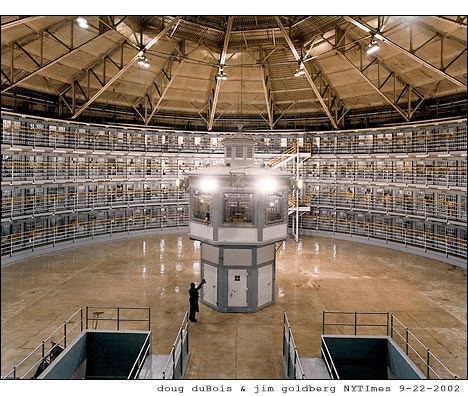
There are different types of surveillance that have been discussed by Foucault. Formal or external surveillance is an increasing feature of contemporary society through the use of CCTV and the monitoring of online activity, etc. This model put forward consists of a process of the means watching the few where in there is one individual or a small team being the centre of an area so that a smaller team can watch a larger group or room of people. Foucault argues that this mean of monitoring people within society or jail makes ii so that we are so aware that we are already now effectively monitoring ourselves through internal surveillance. Through the fear of being watched and possibly punished by an unseen force. (Elmer 2003) (Foucault 2007)
However in a modern society the ethics of more technological based surveillance can be largely abused when used by the wrong individuals such as state police who monitor certain minority or similar perceived to be volatile groups (Hier, S.P. & Greenberg, J. 2007). International law says that people have certain human rights, including the right to freedom of expression, the right to association and the right to protest (UN 1948). Nonetheless, scepticism as to the intentions of a state will contribute to cynicism as to how the state will use its surveillance technology to defend itself. Nonetheless, even if there was no evidence of criminal activity, the state could choose to keep a record of all those who publicly acknowledge to a certain opinion or choose to associate with all who the state suspects pose a threat. (Beer, D., and Penfold-Mounce, R 2009)
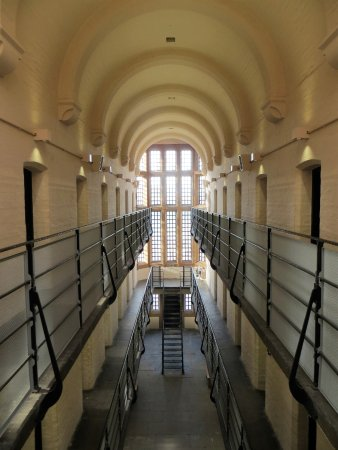
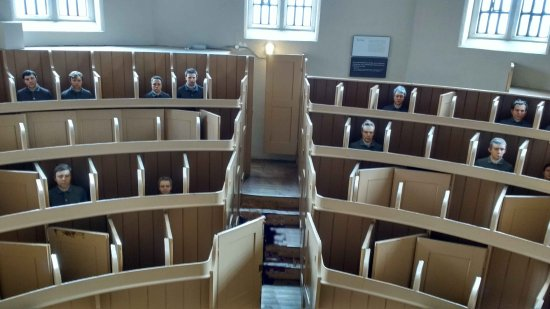
The prisons of Lincoln Castle do have an involvement of Foucault model in areas of the prison such as the chapel which contains isolated seats with walls higher than prisoners as to separate them from each other even when they are outside of the cells. The main feature of the setup of this room however is that of the position of the preachers stand centred as the focal point of the whole room. Therefore allowing for a panoptic view of the whole room where one preacher and maybe a handful of guards would be able to watch the entire room. Especially with the stand being higher than the stalls. Creating a possible atmosphere of a lack of control on the prisoners behalf. This then makes the prisoners more likely to police themselves when they are at chapel due to the sense of vulnerability that room gives them. The panoptic model can also be transferred to other areas of the prison like the prisoners living quarters. Where there is an alternate version of the model where guards are able to have still an overview of the whole section. But in order to properly watch the prisoners they need to wander up and down the railing. Where the guards also have a peephole on all the doors which reinforces the feeling of prisoners policing themselves due to the likelihood of them being suddenly caught by a passing guard. (Deborah, 2013)
Bibliography:
Macnish, K. (2012). Unblinking eyes: The ethics of automating surveillance. Ethics and Information Technology, 14(2), .
Deborah, L. (2013, December 16). The Sociological Life. [Weblog]. Retrieved 14 January 2020, from https://simplysociology.wordpress.com/2013/12/16/types-of-surveillance-relevant-to-digital-sociology/ https://www.ukessays.com/referencing/apa/generator/reference.php
Hier, S.P. & Greenberg, J. (eds.) (2007). The surveillance studies reader. Buckingham: Open University Press. Editors’ introduction: contemporary surveillance studies, pp. 1-19.
Foucault, M. (1977). Discipline and punish: the birth of the prison (1977). London: Penguin. Part 3, Chapter 3 in particular.
Beer, D., and Penfold-Mounce, R. (2009). ‘Celebrity gossip and the new melodramatic imagination’, Sociological Research Online 14(2).
Elmer, G. (2003). ‘A diagram of panoptic surveillance’, New Media and Society 5 (2): 231-247.
Information society: Are whistle-blowers important, or dangerous, members of an information-rich society
In support of the Social Audit Report on the subject, John Banham, Director General of the Confederation of British Industry, wrote this (Winfield 1990). .The issue of whistleblowing is the accomplishing a large amount of prominence as a matter of social policy. Many figure heads have suggested that it may be a highly noble or a selfless action for somebody to undertake in certain circumstances. This therefore necessarily means immense risks for the activist, and these risks must be treated individually and carefully. (Barlett, 2015)
Whistleblowing can be largely blown out of proportion in a modern society which is rife with a large amount Rockstar culture where peoples fame blows up very easily due to the ease of sharing videos and news through social (McGuigan, 2006) media and messages. The uses of social media are different, however they all of a similar focus or goal in mind which is supposed to be their direct main use. This main goal or use and the very essence of social media is that of communication between people be it around the world or down the street. Which means that people can share thoughts; people can share information; people can share humorous or offensive photos and videos. Anything can be shared by anyone and made to go viral. (Beckett, 2012) Social media has the power to influence social change in society. Social media has empowered thousands, if not millions, of people to have a voice and distribute the information that the consumer thinks is relevant and important. Unfortunately, it can encourage a mob mentality when it comes to volatile topics such as whist blowers. (Riddle , 2017)
I conducted my own research into those who work within 2 different industries one was my father who is an employee in the tourism industry and I got my their opinion of what how useful whist blowers can be. ‘Whistle-blowers can be so useful for companies as it enables to see problems that they might not have noticed.’(Michael, personal communication, 18/01/2020) Constructive criticism helps companies to grow and improve their services. However, negative reviews online sometimes need to be taken with a pinch of salt. There are customers/ visitors who will leave a negative comment just to gain attention, when actually the incident did not need addressing or was not actually important or relevant. There is also a ‘snowball effect’ seen when it comes to whistle-blowers. A small incident can be blown out of proportion by social media, one negative experience could be posted on social media and be seen by hundreds. Also, as someone who works in the tourism industry, the way a customer/ visitor is first treated, and their first impressions often set the tone for the whole trip. For example, if a visitor has a check-in that was delayed, or there was a problem with their room, it will cast a negative light on the whole trip. On the other hand, if they have a positive first impression, they are more forgiving if things do go wrong. For example, if a visitor checked in and the room wasn’t up to their standards, and then had to wait in a queue to visit an attraction later that day, they will have a more negative view of the attraction they visited. (Boczkowski, 2010)
A second interview that I undertook was that of a civil servant who works for a local council meaning that she deal with certain sensitive materials that cannot be spread around to the public due to safety concerns, therefore making Whistle-blowers a good part of catching mistakes and those who are out for personal gain (Eleishia, Personal communication 18/01/2020). Mistakes are often made by companies in an ever-changing world with fast-changing rules. Whistle-blowers can help highlight new issues and concerns that arise with this new, modern world. For example, whistle-blowers help make tourism more inclusive for non-binary people, with application forms and sign-up sheets, where they speak up and ask for the gender-neutral title Mx to be used. There is more awareness of invisible disabilities, and companies also need to learn what that means for their access points and inclusivity. This could mean allowing public access to gender-neutral toilets or adding to or adapting the wheelchair symbol to be inclusive of those who don’t look disabled but need support, whether that is in lifts, ramps or toilets. Companies are also starting to make gender-neutral baby-changing facilities or include them in men’s’ toilets so single fathers, or men in a same-sex relationship with children can properly care for them. (Rogers, 2015)
A third interview that i conucted was that with the frequent traveler Joanne who i have interviewed in past posts. ‘I think whistleblowing should be discreetly and privately, with the company or employee. This is a more polite and well-mannered way of dealing with issues. If I have an issue with a meal or attraction, I do not immediately write a social media post or negative review about it.'(Joanne, Personal Communication 18/01/2020) If it is serious or reoccurring, my interviewee said she will directly contact the company or a manager to discuss the issue. Common issues that have been have experienced in tourist attractions is: attractions/ exhibitions not being available on the day of travel and food issues. My interviewee said she has experienced food poisoning from a tourist attraction. When most people tell a member of staff discreetly, they are almost always ready and willing to fix the problem. This is the way many people think because it highlights a problem with service without blowing it out of proportion. Negative reviews can cause problems to ricochet and become larger than they realistically were at the time.(Jeff, 2018)
Whistleblowing culture is a good thing as it forces companies to improve their ethical standards, quality of customer service and working conditions of employees. Employers should establish an environment of trust, respect and order and act ethically towards their employees and the general public. One significant positive to whistleblowing is that it calls out a culture of racism, discrimination and sexual harassment in the workplace. As employees become more aware of the rights they have as a whistle-blower means more people will come forward and expose potentially unethical practices. For example, casual and seasonal workers may often be treated unfairly as they are not considered permanent employees so do not receive the same treatment and training. This is significant as tourism is affected by the seasons, whether that is summer attractions or attractions based on the school year/ university semesters. (Vinciworks, 2019) Whistleblowing culture means any kind of employee can seek advice from a manager, colleague or external agency regarding the issue. More information is made available, which means solutions to these issues are more likely to be found. (Mcgrath, 2019)
Bibliography:
Bartlett, J. (2015). The dark net: inside the digital underworld. London: Windmill Books.
Beckett, C. (2012). WikiLeaks: news in the networked era. Cambridge: Polity.
Boczkowski, P. (2010). News at work: imitation in an age of information abundance. Chicago: Chicago University Press.
Jeff. (2018, June 17). The Psychology Behind Negative Reviews and How to Respond. [Weblog]. Retrieved 30 January 2020, from https://telio.co/blog/reputation-management/psychology-behind-negative-reviews-what-you-can-do/ Go back and edit info
Lyon, D. (2015). Surveillance after Snowden. Cambridge: Polity.
McGuigan, J. (2006). Modernity and postmodern culture. Maidenhead: Open University Press. Chapter 5.
Mcgrath, C. (2019, 19 June). Whistleblowing v grievance: how should sexual harassment be raised?. [Weblog]. Retrieved 24 January 2020, from https://www.personneltoday.com/hr/whistleblowing-v-grievance-how-should-sexual-harassment-be-investigated/ Go back and edit info
Riddle , J. (2017, march 1). THE ARKANSAS JOURNAL OF SOCIAL CHANGE AND PUBLIC SERVICE. [Weblog]. Retrieved 29 January 2020, from https://ualr.edu/socialchange/2017/03/01/blog-riddle-social-media/
Rogers, D. (2015). Campaigns that shook the world: the evolution of public relations. London: Kogan Page.
Vinciworks. (2019, 19 November). VinciWorks’ whistleblowing portal – Provide seamless, anonymous reporting. [Weblog]. Retrieved 24 January 2020, from https://vinciworks.com/blog/harassment-whistleblowing-portal-provide-seamless-reporting-on-sexual-harassment/ Go back and edit info
Globalization: Pursue an ethnography of a locale/shop/space of your choice within Lincoln town centre with the following questions in mind: a) in what ways is that locale/shop/space “disembedded” from its local surroundings? And in what ways is it then “re-embedded” within various national/international/global flows?
Globalisation brings more and more cultures closer together around the world allowing for the different cultures of different countries such as the food and music from one country becoming mainstream in another country.(Martell 2010) Which allows for 3rd world countries to develop more due to the demand for their countries products putting money into communities and businesses. Disembedding is the lifting from local interaction contexts of social relations and their restructuring across indefinite spans of time-space. (Giddens, 1990) The world is taking advantage of a global food supply chain and quinoa is an empirical example. Peruvian farmers not only benefit financially from rising consumer demand for grain in richer countries, as detailed in a study conducted by University of Minnesota’s Marc Bellemare, the local economy is strengthening as successful quinoa farmers who have more buying power then buy more products from their surrounding Peruvians. The world is taking advantage of a global food supply chain and quinoa is an empirical example. (Giddens, G 1999)
In Lincoln there are many vintage and antique shops. These kinds of shops can have a long history in their town. Some antique shops in Lincoln sell Lincoln-based antiques that are unique to the town and their history, whether that is from industrial or war-time era. Vintage shops are also trendy and often have an online presence and following.(Pieterse 2015) Vintage shops often have Facebook and Instagram pages, where it directly targets its demographic audience and introduces more people to shop vintage and visit their shop. Vintage shops are becoming increasingly popular on a global scale, as seen by digital companies like ‘Fashion Revolution’ that highlight how shopping vintage and second-hand items can have a positive impact on the environment and economy. These shops that have a digital footprint also attract online business. Whilst customers may not travel to Lincoln, they might shop online at vintage, one-off or boutique stores and help support these businesses and allow them to have a physical store, which further supports Lincoln’s economy. (Urry, 2014)
Local coffee shops and cafes can be displaced from Lincoln town centre in lieu of high street brands and chains. Giant, national or global chains like Starbucks or Wetherspoons are becoming increasingly popular as whoen by the images below showing the 2 menus from both the UK and Dubai(Wagamamas 2020). They are considered more consistent, are usually cheaper and are already well-known so they don’t have to establish themselves in a new town. Their preceding reputation and social media following follows them to new locations and towns they open up in. this has been a growing problem for years but society is slowly turning back towards local and indie brands. There is more of a social awareness of ‘Shop Local’ and supporting your local coffee shop or café, so people make more of an effort to go elsewhere instead of immediately thinking of Starbucks or Wetherspoons. This is supported by local cafes and coffee shops supporting each other, there are food and drink trails in Lincoln, where you can visit a unique tea room, them a bakery, then a local pub. I have also seen local businesses work together on offer, sometimes a local coffee shop will run a student discount, or provide an offer in collaboration with another shop, or run competitions and giveaways. They also get involved online and have a presence on TripAdvisor and Facebook and have ways of interacting with the wider public and potential customers. (Castells 2000)
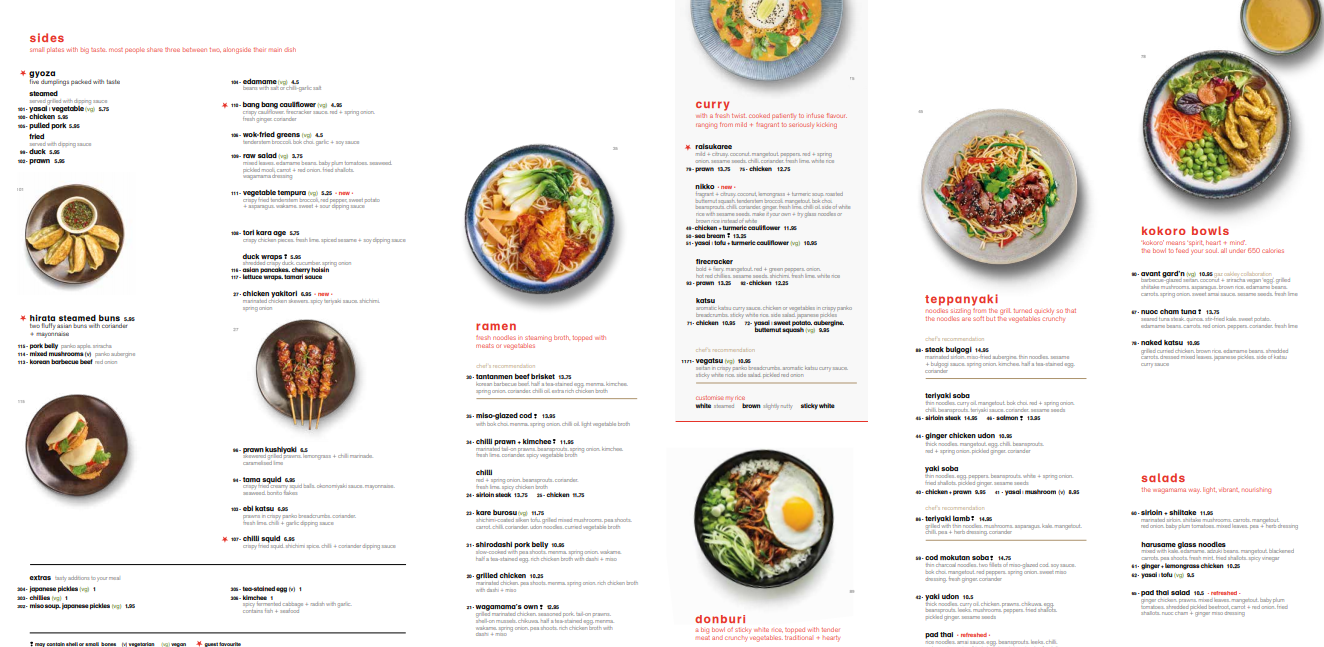
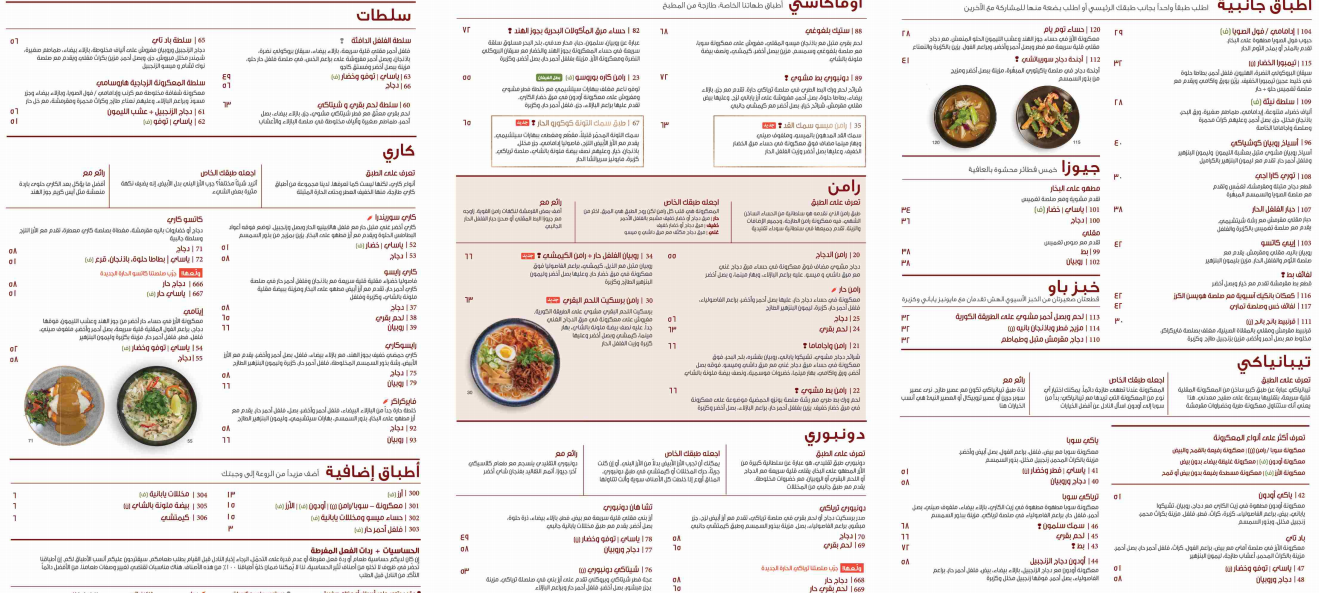
Globalisation has caused the embedding of many new food cultures in different countries. For example the franchise of Wagamama’s which is an Asian inspired restaurant chain. Which varies in location from Blegium, Cyprus all the way to New Zealand and Dubai. It shows how the culture of Asian cuisine has been lifted out of its origin country and shared with the whole world due to its large popularity. The Disembedding of this culture can be seen by the fact that Wagamama’s originated within the UK and was appropriated by chefs in Britain in order to make the cuisine local, more accessible to the public and as a means of creating a niche market to attract a new clientele. An example of this clientele are those who come from the country the food is inspired by allowing for a home away from home. (Waddington, 2015)
I used another opinion of a frequent traveler who i have used before in order to get a member of the public’s perspective on how they think globalisation has effected the city of Lincoln and how they think cultures have been ’embedded’ into the community, allowing me to gain a helpful second perspective on the effects of an ever changing world. ‘Globalisation is a good thing because people travel from abroad to visit Lincoln and England for the history. People from abroad are attracted to Lincoln for lots of different reasons because it has a lot to offer. Globalisation has made people aware of its existence and puts Lincoln on the map for global/ international tourists.'(Joanne Personal Communication 19/01/2020) People I have spoken to are interested in Lincoln for their quirky shops, the Cathedral, the waterfront and views. Lincoln’s is a tourist destination for people looking for unique attractions. Lincoln is unique and interesting because of its deep history and how it is represented in different ways. Quirky shops like vintage and boutique shops offer one-off finds, the waterfront shows the literal history of the harbour and the Cathedral shows incredible architecture. (Tripadvisor, c2020)
Bibliography:
Castells, M. (2000) The rise of the network society, 2nd edition. Oxford: Blackwell. Chapters 1, 5 and 6.
Giddens, G. (1990) The consequences of modernity. Cambridge: Polity Press.
Giddens, G. (1999). Runaway world: how globalisation is shaping our lives. London: Profile Books.
Martell, L. (2010). The sociology of globalization. Cambridge: Polity Press.
Pieterse, J N (2015). Globalization and culture: global melange (3rd edition). Lanham, MD: Rowman and Littlefield. Chapter 3.
Tripadvisor. (c2020). Antique Stores in Lincolnshire. Retrieved 22 January, 2020, from https://www.tripadvisor.co.uk/Attractions-g186335-Activities-c26-t137-Lincolnshire_England.html Go back and edit info
Urry, J. (2014). Offshoring. Cambridge: Polity.
Waddington, J. (2015, 3 Feb). Coventry Live. [Weblog]. Retrieved 24 January 2020, from https://www.coventrytelegraph.net/whats-on/food-drink-news/whats-wagamama-like-you-need-8573336
Wagamama, (2020). Menu Items [photograph]. https://www.wagamama.com/our-menu
The tourist gaze: “The ‘tourist gaze’ is not a matter of individual psychology but of socially patterned and learnt ways of seeing” (Urry and Larsen, 2011: 2). To what extent is the City of Lincoln’s status as a tourist destination the effect of “learnt ways of seeing”? Who are the professionals organizing the tourist gaze in Lincoln? How do they do so? And how is the tourist gaze consumed by tourists?
Urry’s ‘tourist gaze’ remains one of the most influential concepts in tourism research. Urry’s theories are still widely cited and relevant today, but a major criticism of his research is that too much emphasis is placed on the visual aspects of being a visitor rather than on the entire experience. In order to fully understand the ‘tourist gaze’ it would be useful to have a clear understanding of what a tourist is and what tourism as an activity is. (Turner et al. 2005) defines a tourist as “a person who has travelled to another place for a brief stay, an experience that necessarily involves a distinct period of transition from the everyday world”. (Urry 1990)
Social media and digitisation of information has changed tourism. The age of social media makes everything more accessible and readily available. You don’t even have to visit Lincoln to start planning ahead and knowing everywhere you should go. Websites like TripAdvisor and Facebook provide an insight into the different tourist attractions available and they rely on reviews and ratings from the public. (Urry, 1992) And on the other side, if an attraction does not have a digital footprint, it may go unnoticed and lose out on visitors who planned their trip online. The official website for Lincoln, visitlincoln.co.uk even has digital tours. You can now take a thorough, informative tour without a tour guide, all you need is a smartphone. Having information online also makes things more efficient, you know exactly where to go on different days and times. You know which pub to go see live music at by searching on Facebook, you know the Castle is open late certain days of the week. It also lets you plan for those who need disabled access, or need a braille handbook, or are vegan or coeliac. The information is all readily available so there is less chance of making mistakes or missing out. However, it also takes the spontaneity out of the trip. For some, you’ve already seen a digital tour of the castle before you get there, you’ve searched the hashtag #visitlincoln and seen incredible photos like the ones you’re going to take. Nowadays, you are never surprised by visiting somewhere new as all the information is there already. (Cohen, 1984)
There are ‘learnt ways of seeing’ (Berger, 1972) places depending on what the reputation of the town is. Lincoln is to some a historical town, to others a student/ university town and to others are a mix of both. Tourism in Lincoln shows 2 major themes: history and nightlife. This is seen in the 2 major attractions in Lincoln: Lincoln heritage and Lincoln night life. Lincoln is a town with 2 universities and several different colleges and sixth forms. There are different views on Lincoln based on if you are interested. If you are in the demographic of a student or young adult, then often your view is skewed towards socialising, night life and parties. This is seen on TripAdvisor, where there are multiple lists and rankings of the different pubs, bars and clubs in Lincoln. This is combined with social media like Facebook being full of invites to parties, student nights, themed nights, live music and competitions. However, there is a shift as more heritage and historical attractions make their advertising more appealing to a younger audience. For example, the ‘Lincoln Imp’, a well-known mascot, is being used for a Lincoln Imp Trail which will highlight hidden gems and historical places of interest that are not known to the wider public or to a younger audience. This combines 2 major tourist themes, nightlife and heritage as it targets a younger demographic to explore historical sights and nightlife. (Graham, 1991)
I have conducted my own research into how people view the tourism aspects of Lincoln and what aspects of the area they feel they are attracted towards. Lincoln Cathedral, Lincoln’s Brayford Waterfront (Joanne Personal Communication 18/01/2020) are the most well-known tourist attractions. If you mention Lincoln to others, they always comment that it is a nice place by the water and has beautiful views. People specifically mention the waterfront and that it is attractive for people interested in good views and local history, as this is England’s oldest inland harbour. food markets, craft fairs and Christmas markets show a good representation of what is popular in Lincoln.(Visit Lincoln, c2012) There is a big emphasis on local food, drinks and produce. At markets you are encouraged to shop local and support farmers and independent brands, whether this is local ale, whiskey, meat and cheese. Tourism is Lincoln is targeted more towards local and independent brands instead of larger brands. You don’t hear as much talk about the major chains in Lincoln. They are there but not advertised or pushed upon. At the local tourism centre you can find information and guides for the best local butcher, whiskey store and farmers’ shop.
Bibliography:
Berger , J. (1972). Ways Of Seeing. (1st ed.). UK: Penguin.
Cohen, E. (1984). The Sociology of Tourism: Approaches, Issues, and Findings. Annual Reviews, 10(1), 373-392.
Graham, D. (1991). Sociology and tourism. Annals Of Tourism Review, 18(1), 155-169.
Perkins, H.C. and Thorns, D.C. 2001, Gazing or Performing?: Reflections on Urry’s Tourist Gaze in the Context of Contemporary Experience in the Antipodes, International Sociology, 16(2), 185-204.
Turner et al. 2005, The Tourist Gaze: Towards Contextualised Virtual Environments, Kluwer.
Urry, J. 1990, The Tourist Gaze, London: Sage.
Urry, J. 1992, The Tourist Gaze “Revisited”, American Behavioral Scientist, 36, 172-186.
Visit lincoln. (c2012). ABOUT LINCOLN AREAS OF LINCOLN. Retrieved 22 January, 2020, from https://www.visitlincoln.com/about-lincoln/areas-of-lincoln/ Go back and edit info
Get new content delivered directly to your inbox.
 Sociology